






Organic Pollutants in Food, the Environment and Human Biomonitoring
Modern society produces and uses thousands of chemical substances which, once released, can enter the environment, the food chain, and the human body. Some of these substances are persistent, meaning that they can accumulate in the environment and living organisms over time, potentially posing a risk to ecosystems and human health. Our research group studies organic pollutants throughout their entire life cycle, from sources of environmental pollution and their transfer into food to the assessment of human exposure through biomonitoring. We focus in particular on persistent organic pollutants, such as brominated flame retardants (BFRs), polychlorinated biphenyls (PCBs), organochlorine pesticides (OCPs), chlorinated paraffins (CPs), and per- and polyfluoroalkyl substances (PFAS), often referred to as ‘forever chemicals’. We also investigate polycyclic aromatic hydrocarbons (PAHs), UV filters, plastic additives (phthalates, bisphenols, etc.) and organophosphate flame retardants (OPFRs). To analyse these compounds, we develop and apply modern multi-analytical methods based on gas and liquid chromatography combined with mass spectrometry.
Research topics
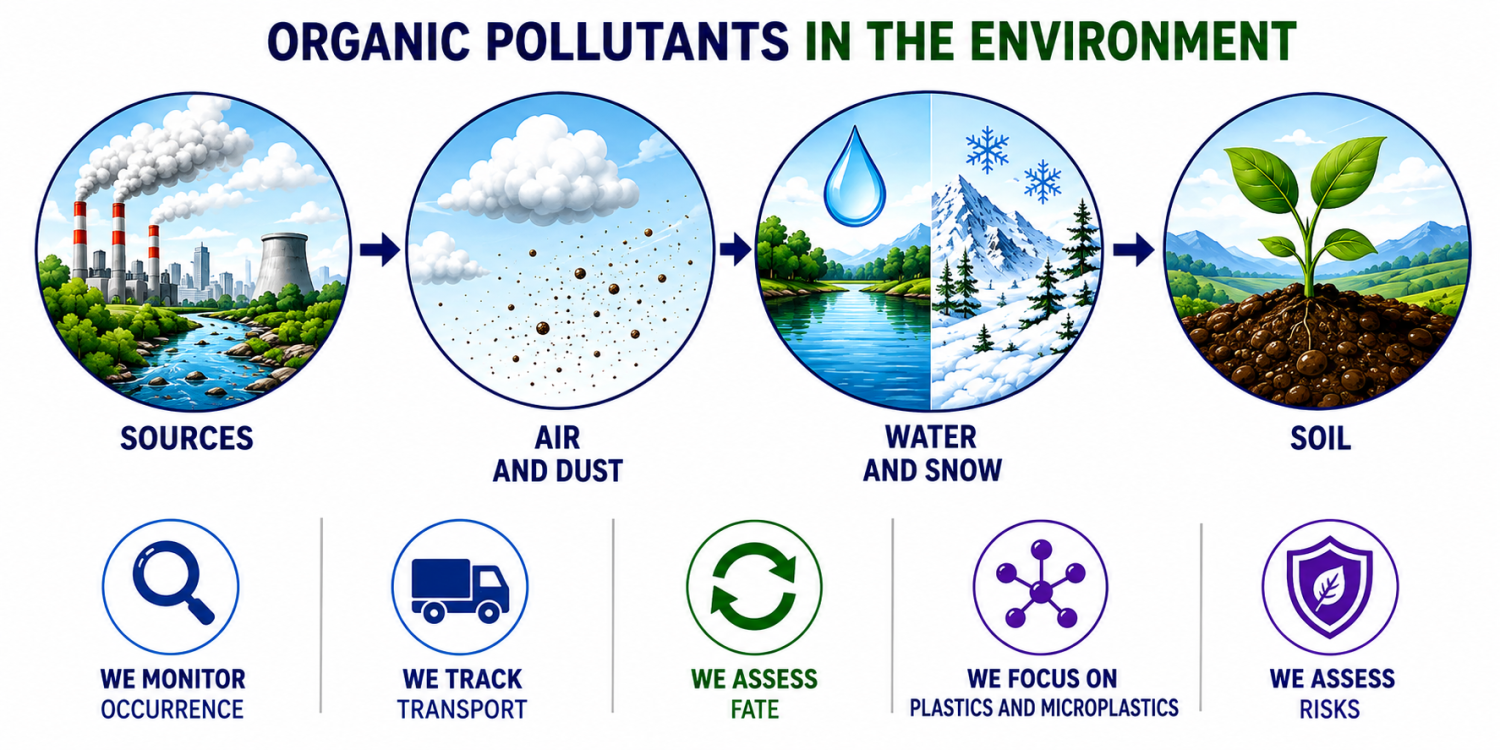
Organic Pollutants in the Environment
How do pollutants enter the environment, and what happens to them afterwards? We study the occurrence, transport, and fate of organic pollutants in water, soil, sediments, air, snow, and dust. We investigate their sources, how they spread through the environment, where they accumulate, and how long they persist. We also focus on substances associated with plastics, including microplastics and plastic additives. We investigate how these additives are released into the environment and whether microplastics can act as carriers and reservoirs of chemical substances. Our research helps us better understand pollution sources and spread, human exposure, and environmental risks, and contributes to more effective approaches to environmental monitoring and protection.
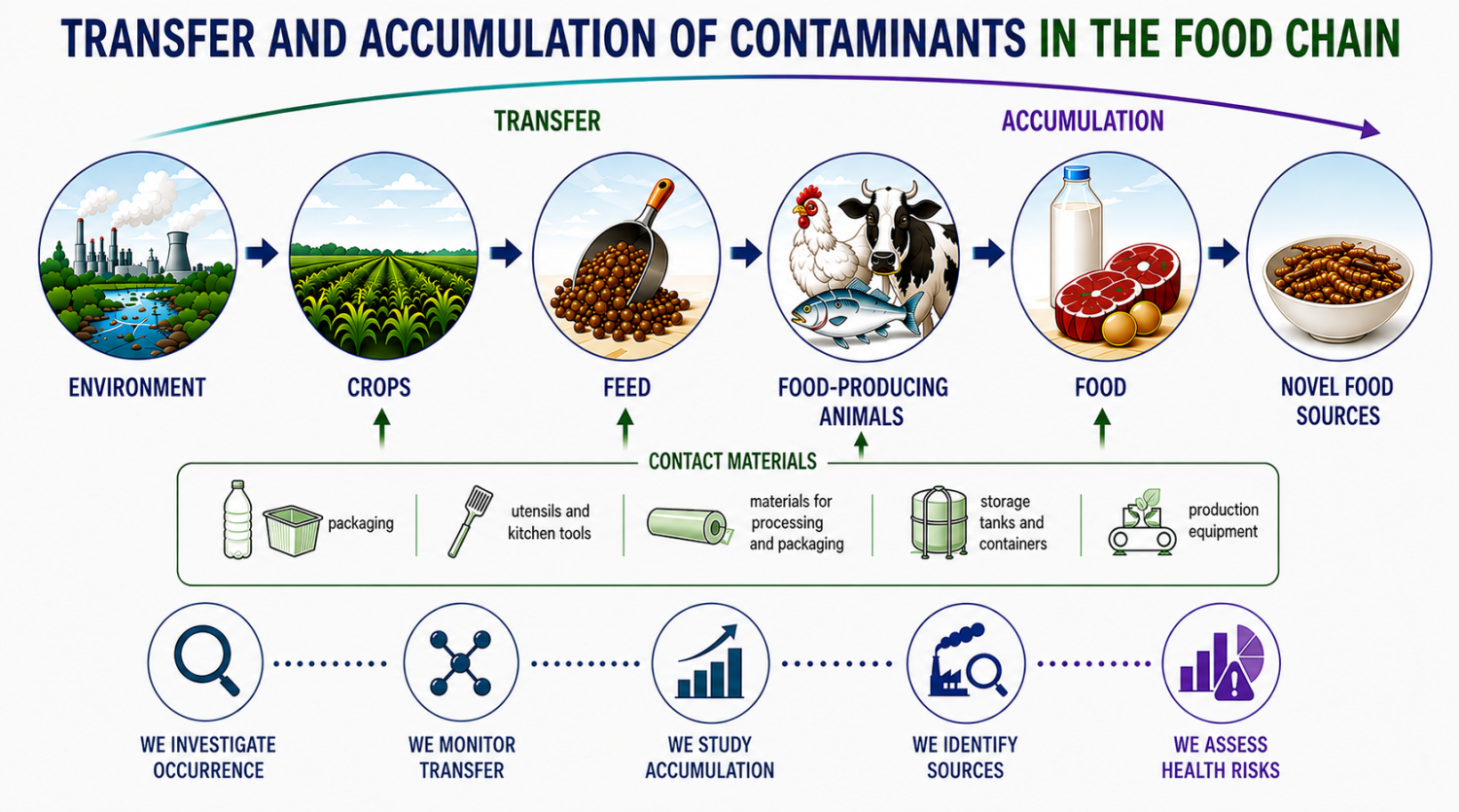
Organic Pollutants in the Food Chain
What happens to pollutants when they enter the food chain from the environment? We study how organic contaminants enter the food chain and how they transfer and accumulate within it. We investigate the occurrence of contaminants in agricultural crops, food, animal feed, and organisms, as well as the factors influencing their presence and accumulation. We analyse food, agricultural commodities, food supplements, and novel food sources, such as edible insects. We also focus on food packaging and other food contact materials, from which undesirable chemicals may migrate into food. Using modern analytical methods, we monitor the occurrence, transfer and bioaccumulation of contaminants, and we use the data obtained to estimate human dietary exposure. Our research contributes to the assessment of food safety and potential health risks associated with chemical contamination.
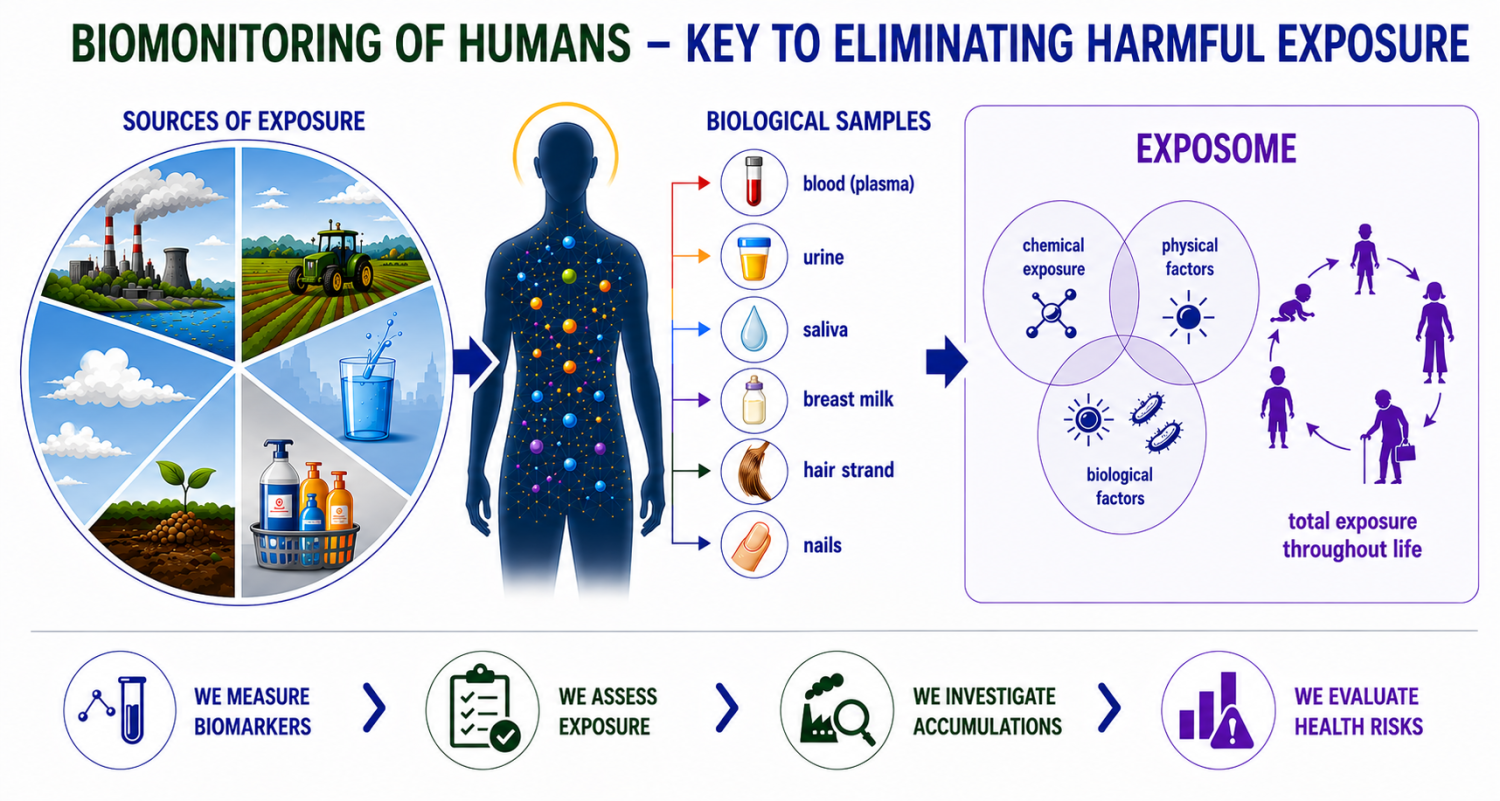
Organic Pollutants and their Metabolites in the Body
How many chemicals actually enter our bodies, and what happens to them afterwards? Through human biomonitoring, we investigate organic contaminants in blood, urine, breast milk, and other biological samples. We focus not only on the contaminants themselves, but also on their metabolites and how they are distributed, transformed, and excreted in the body. Our research also covers emerging and less-studied substances for which population exposure levels need to be determined. Using advanced analytical methods, we can detect even very low concentrations of these substances in complex biological matrices. The data obtained allow us to compare exposure across different population groups and better understand the overall chemical burden on humans within the exposome concept. We use these results to identify groups with higher exposure, assess potential health risks, and support the development of human biomonitoring programmes.
Gomersall V., Ciglová K., Parizek O., Rössnerová A., Rössner P. Jr., Sram R. J., Topinka J., Pulkrabová J.: Biomarkers of exposure to polycyclic aromatic hydrocarbons in the urine of municipal police officers: impact of inhalation on total exposure. Environmental Science and Pollution Research (2025) 32: 11097–11113. (doi: 10.1007/s11356-025-36342-2)
Kozisek F., Dvorakova D., Kotal F., Jeligova H., Mayerova L., Svobodova V., Jurikova M., Gomersall V., Pulkrabova J.: Assessing PFAS in drinking water: Insights from the Czech Republic’s risk-based monitoring approach. Chemosphere (2025) 370: 143969. (doi: 10.1016/j.chemosphere.2024.143969)
Dvorakova D., Pernica M., Svobodova V., Pulkrabova J., Belakova S.: PFAS in the Brewing Chain: Occurrence in Drinking Water and Beer – A Pilot Study. Kvasny prumysl (2026) 72(3): 1207–1214. (doi: 10.18832/kp2026.72.1207)
Parizkova D., Parizek O., Tomasko J., Pitrak M., Pulkrabova J.: Integrated assessment of dermal and inhalation exposure to chlorinated paraffins using personal silicone wristbands and measurement of skin contamination. Environmental Pollution (2026) 406: 128669. (doi: 10.1016/j.envpol.2026.128669)
PARC - European Partnership for the Risk Assessment of Chemical Substances (EC, Horizon Europe; 2022–2029)
LUC25019 Comprehensive strategy for ensuring the safe production of edible insects with high nutritional value (MSMT; 2025–2028)
LUC25123 Investigation of the nutritional benefits and monitoring of contaminants in bee products (MSMT; 2025–2027)
SS07020436 Identification and management of point sources of PFAA pollution in the anthropogenic water cycle (TACR; 2024–2026
QL24010123 Reproductive disorders in bees – contamination of bee colonies with harmful substances (Ministry of Agriculture; 2024–2028)