






Food Sensing and Rapid Analytics
Our group develops innovative analytical approaches to address challenges in food quality, safety, authenticity, and bioactivity. Our research encompasses rapid sensing technologies, enzyme-based bioactivity assays, vibrational spectroscopy, and advanced data analysis to acquire reliable chemical information about foods and food-derived compounds. We focus on the development and validation of robust analytical methods for screening food contaminants, assessing food authenticity, and identifying bioactive molecules with potential health benefits. A key aspect of our work is translating laboratory methods into practical solutions and engage smartphone-based detection for on-site applications. By integrating analytical and food chemistry, chemometrics, and sensor technologies, we aim to support evidence-based innovation across the food supply chain. Ultimately, our mission is to contribute to safer, more authentic, and functionally enhanced food products while advancing the field of rapid food analysis.
Research topics
Enzyme Inhibition Assays to Identify Food and Plant Functional Properties
Our research activities exploit enzyme inhibition assays as analytical tools to identify bioactive compounds in foods and edible plants. Enzymes regulate key physiological processes, and their excessive activity is often associated with a disease state. Therefore, natural enzyme inhibitors from food sources modulating enzyme activity represent promising candidates for functional foods and nutraceuticals. Our primary goal is the development and optimisation of reliable enzyme assays. Many published protocols lack sufficient validation, limiting reproducibility, and biological relevance. We prioritise robust in‑house optimisation to ensure high analytical performance and meaningful interpretation of results. We have been developing several enzyme assays focusing on enzyme with important biochemical functions. Indicatively, we have been studying enzymes related to cognitive function (acetylcholinesterase, butyrylcholinesterase), digestion (pancreatic lipase, α‑amylase, α‑glucosidase), and skin health (tyrosinase, elastase). To strengthen biological interpretation, enzyme inhibition screening is combined with targeted metabolomics employed within our Department. Integrating enzymatic, chemical, and chemometric data enables the identification of bioactive molecules linked to inhibitory effects, supporting the evidence‑based development of novel functional foods.
Youtube video demonstrating the concept of enzyme inhibition assays
Smartphone-Based Assays for Food Contaminant Screening
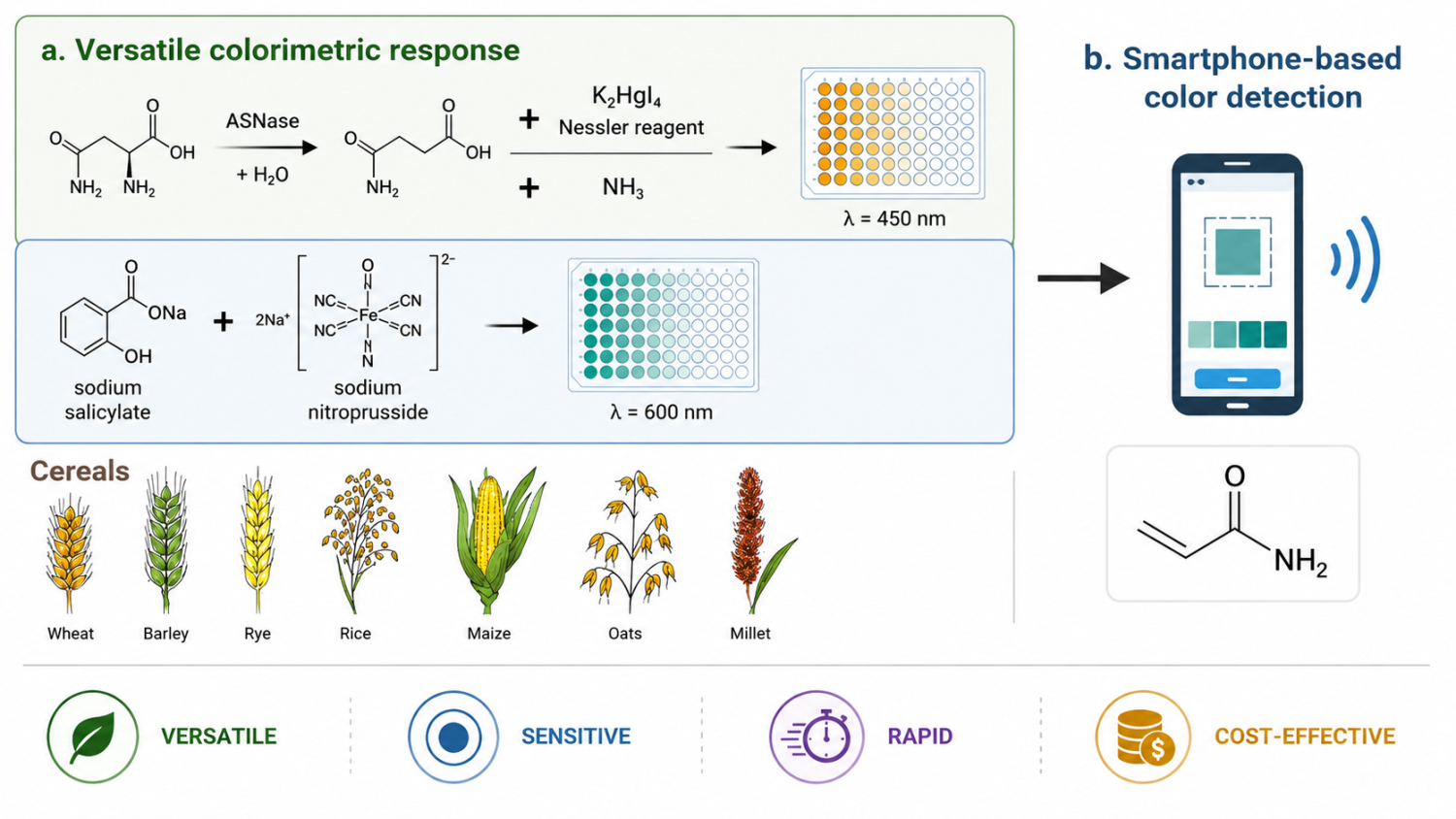
We are exploring the use of smartphones as analytical detection platforms for rapid, cost‑effective, and decentralized food analysis. Smartphones offer unique capabilities, including on‑site data acquisition, semi-quantitative results at the point of need, geolocation, and real‑time data communication, making them highly attractive for modern food safety applications. A major focus of our work is the development of smartphone‑integrated analytical tools for screening food contaminants. This research requires a multidisciplinary approach, combining analytical chemistry, sensor development, optics, data processing, and user‑oriented design. Our activities cover the full workflow, from assay chemistry and signal generation to data acquisition, processing, and wireless communication. The developed approaches target low molecular weight molecules (e.g., pesticide residues, acrylamide and its precursor asparagine) relevant to food contamination, with emphasis on portability, robustness, and ease of use by non‑specialist operators. We aim to transform smartphones from everyday communication devices into reliable analytical tools, supporting rapid decision‑making and improved food safety.
Functional sample
Test for rapid determination of asparagine in microtiter plates
Rapid and Cost-Effective Food Authenticity Assessment Using Vibrational Spectroscopy
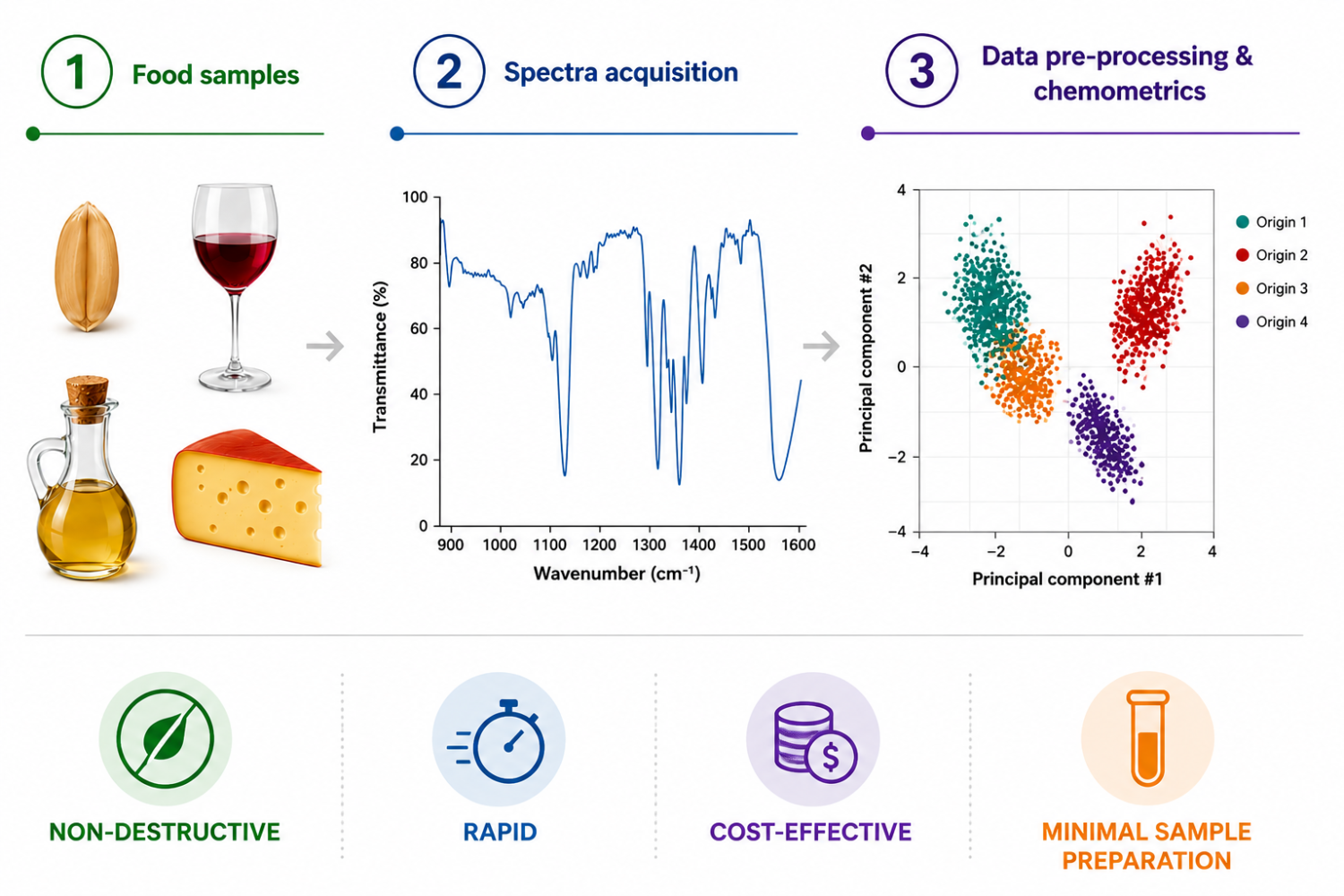
Our research focuses on the application of vibrational spectroscopy as a rapid, non‑destructive, and cost‑effective approach for assessing food authenticity and quality. Techniques such as mid‑infrared (MIR), near‑infrared (NIR), and Raman spectroscopy provide rich molecular fingerprints that can be exploited to verify product identity, origin, and production characteristics. We have demonstrated the potential of MIR spectroscopy for the authentication of food commodities with high market and nutritional value such as cereals, honey, and wine. These analytical workflows can address challenges related to their botanical origin, varietal identity, and vintage discrimination. Emphasis is placed on spectral data pre‑processing and feature selection, as these steps critically influence the robustness and predictability of chemometric models. Beyond laboratory‑based infrared systems, we actively explore portable spectroscopic solutions, including a handheld Raman spectrometer, to support on‑site screening applications. Overall, our work supports the development of reliable screening tools for food authenticity, bridging spectroscopy with practical implementation along the food supply chain.
Kulbat-Warycha K., Tsagkaris A.S., Żyżelewicz D., Oracz J.: White, green and black tea (Camellia sinensis (L.) Kuntze) spray-dried encapsulates as bioactive ingredients in vegan gummies. LWT (2026) 245: 119269. (doi: 10.1016/j.lwt.2026.119269)
Tsagkaris A.S., Cafarella C., Rigano F., Louckova A., Dugo P., Mondello L., Hajslova J.: Bioactive compounds in 19 chili pepper varieties cultivated in Italy: Suspect screening and in vitro enzyme inhibitory effect. Food Research International (2025) 219: 117051. (doi: 10.1016/j.foodres.2025.117051)
Kourimsky T., Tsagkaris A.S., Bechynska K., Koudela M., Hajslova J., Hradecka B.: Potential of vacuum frying on the preparation of carrot crisps and a non-destructive technique for rapid acrylamide detection. Food Chemistry (2026) 517: 149459. (doi: 10.1016/j.foodchem.2026.149459)
Book “Smartphones for Chemical Analysis: From Proof-of-concept to Analytical Applications” edited by J.L.D. Nelis and A.S. Tsagkaris, Comprehensive Analytical Chemistry, Vol. 101, 2023, Elsevier, ISBN 978-0-443-13405-0
Tsagkaris A.S., Kalogiouri N., Tokarova V., Hajslova J.: The impact of spectral data pre-processing on the assessment of red wine vintage through spectroscopic methods. Journal of the Science of Food and Agriculture (2025) 105(11): 5986-5998. (doi: 10.1002/jsfa.14351)
Cafarella C. and Tsagkaris A. S.: Chapter 15 - A pilot study comparing a handheld Raman spectrometer to a benchtop FTIR for expensive edible oil adulteration assessment. Spectrophotometry in Food Analysis: Fundamentals, Applications and Methods (2026), pp. 421-433 (doi: 10.1016/B978-0-443-30132-2.00014-0)
Junior grant of UCT Prague rector (2022) “ In-vitro investigation of plant extract anti-lipase activity followed by high resolution mass spectrometry screening to identify their chemical composition”
TQ03000738 Innovative test for asparagine screening in raw materials used for heat treated foods – prevention of acrylamide formation (TACR; 2024 - 2025)
FoodSmartphone Smartphone analyzers for on-site testing of food quality and safety (Horizon 2020; 2017 - 2021)