






Process Contaminants in Food
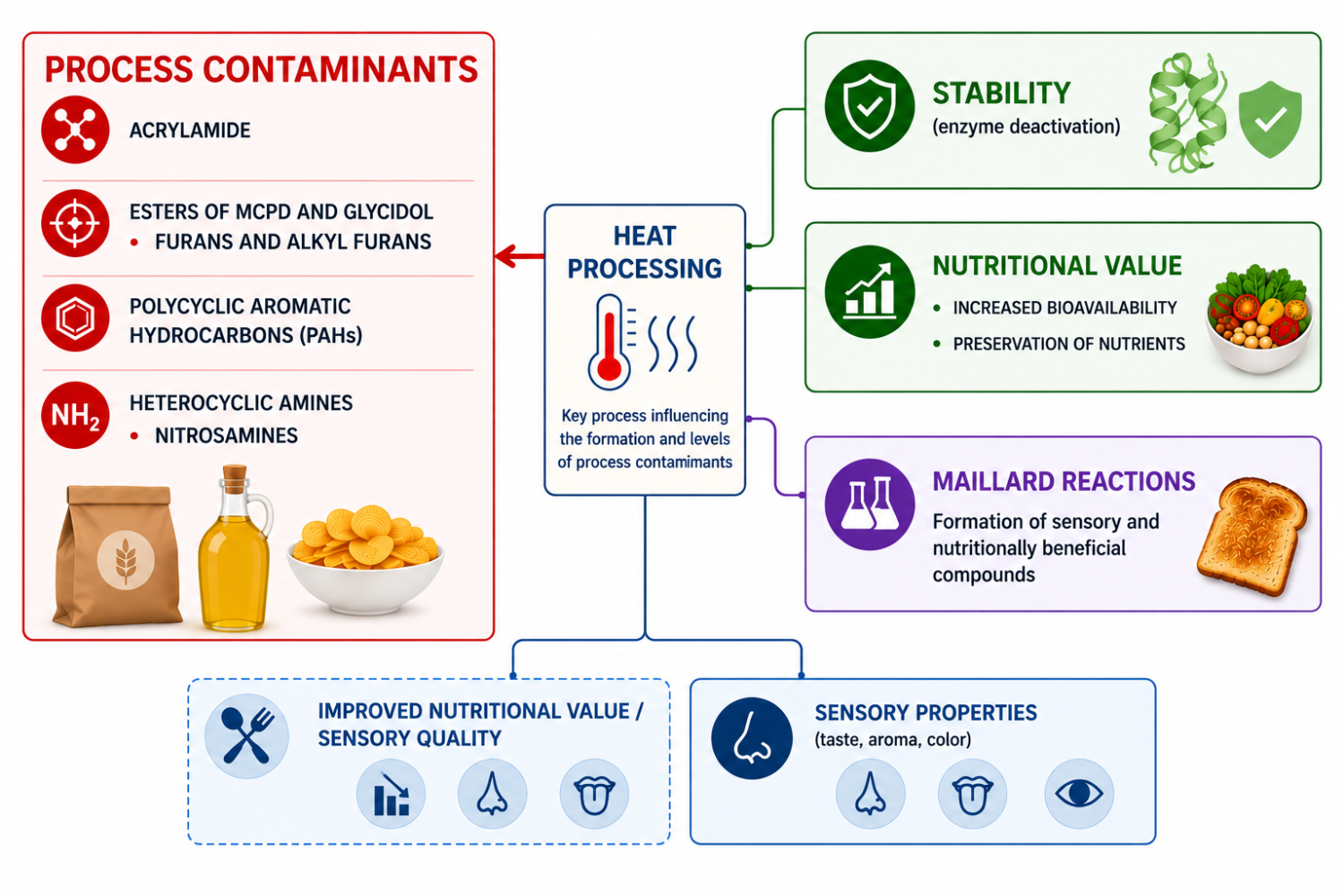
The thermal processing of food serves to ensure microbial safety and extend shelf life, as well as improve digestibility and sensory properties such as taste, aroma, and colour. The formation of these sensory-active compounds involves numerous chemical reactions, the most significant being the Maillard reaction. In addition to desirable attributes, the process can lead to the formation of process contaminants; these have been characterised as probable or potential human carcinogens and therefore constitute a significant group of substances regarding food safety.
In addition to heat treatment itself, the formation of process contaminants is significantly influenced by processing conditions (duration and high temperatures), as well as the composition of the food matrix—specifically, the quantity of precursors present.
Research topics
Acrylamide
Acrylamide is a probable human carcinogen (Group 2A). It is formed through the reaction of reducing sugars (glucose, fructose) with the amino acid asparagine. Foods that contribute significantly to the dietary exposure to acrylamide include, for example, potato crisps, french fries, coffee, and cereal products (e.g., bread, breakfast cereals). To determine acrylamide, we use the UPLC-MS/MS technique.
3-MCPD is a potential human carcinogen (Group 2B). The primary precursors of the esters-bound form of 3-MCPD are lipids (monoacylglycerols, diacylglycerols, or phospholipids) that react with chloride ions (e.g., table salt) or organochlorine compounds. Their formation is closely related to oil refining, but they also occur during food preparation.
Glycidol is a probable human carcinogen (Group 2B). The main precursors of the ester-bound form of glycidol are diacylglycerols and monoacylglycerols. Glycidyl esters are formed primarily during the oil refining process.
We use GC-MS/MS or UPLC-HRMS techniques to determine these process contaminants.
Furan and Alkylfurans
Furan is a potential human carcinogen (Group 2B). Its formation involves numerous precursors, such as reducing sugars, amino acids, polyunsaturated fatty acids, carotenoids, and ascorbic acid. Coffee contributes significantly to dietary exposure to furan and its derivatives. Another dietary source of furan is sterile foods; toddlers represent a high-risk group in this context, as such foods often constitute their primary source of nutrients. We use SPME-GC-MS/MS and SPME-GC-HRMS techniques to determine furan and its derivatives.
Our research focuses on:
(i) The development and application of sophisticated analytical methods for the detection of process contaminants. These methods enable sensitive detection, reliable identification, and quantification in complex food matrices. Accredited methods according to EN ISO/IEC 17025:2018 are used for the determination of the aforementioned contaminants.
(ii) Monitoring the impact of processing conditions on the formation of process contaminants and characterising their occurrence in foods. An integral part of this work is to evaluate the influence of alternative food processing technologies (e.g., vacuum frying, ohmic heating (OH), pulsed electric fields (PEF), high-pressure thermal sterilisation (HPTS)) with the aim of minimising the levels of process contaminants while preserving the nutritional and sensory quality of the food.
Kourimsky T., Tomasko J., Hradecka B., Hrbek V., Kyselka J., Pulkrabova J., Hajslova J.: Chlorinated paraffins as chlorine donors for the formation of 2- and 3-chloropropanediols in refined vegetable oils. Food Chemistry (2025) 465/1: 141919. (doi: j.foodchem.2024.141919)
Hradecka B., Stara L., Kourimsky T., Stupak M., Svec I., Slukova M., Skrivan P., Hajslova J.: Salty crackers enriched with cricket (Acheta domesticus) powder: a comprehensive quality and safety assessment study. Food Chemistry: X (2025) 30: 102918. (doi: 10.1016/j.fochx.2025.102918)
Kourimsky T., Tsagkaris A.S., Bechynska K., Koudela M., Hajslova J., Hradecka B.: Potential of vacuum frying on the preparation of carrot crisps and a non-destructive technique for rapid acrylamide detection. Food Chemistry (2026) 517: 149459. (doi: 10.1016/j.foodchem.2026.149459)