






Volatile and Semi-volatile Compounds and Volatilomics
The research focuses on the analytical characterization of volatile and semi-volatile organic compounds in complex food, plant, and other matrices. We employ gas chromatography coupled with tandem mass spectrometry (GC-MS/MS) and gas chromatography coupled with high-resolution mass spectrometry (GC-HRMS) for the sensitive determination and reliable identification of a broad range of analytes. For sample preparation, we apply various extraction and preconcentration techniques, particularly solid-phase microextraction (SPME), SPME Arrow, and the CENTRI system, selecting the appropriate approach according to the properties of the matrix and target compounds. The combination of these approaches enables high sensitivity and selectivity in the analysis of complex samples while providing information suitable for both qualitative and quantitative assessment. We focus on the development, optimization, and validation of analytical methods and their application in the evaluation of food quality and safety, characterization of plant materials, and monitoring of changes induced by technological processing or storage. Our research activities also include the identification of markers that enable the differentiation of the origin, quality, or technological processing of the analyzed materials.
Research topics
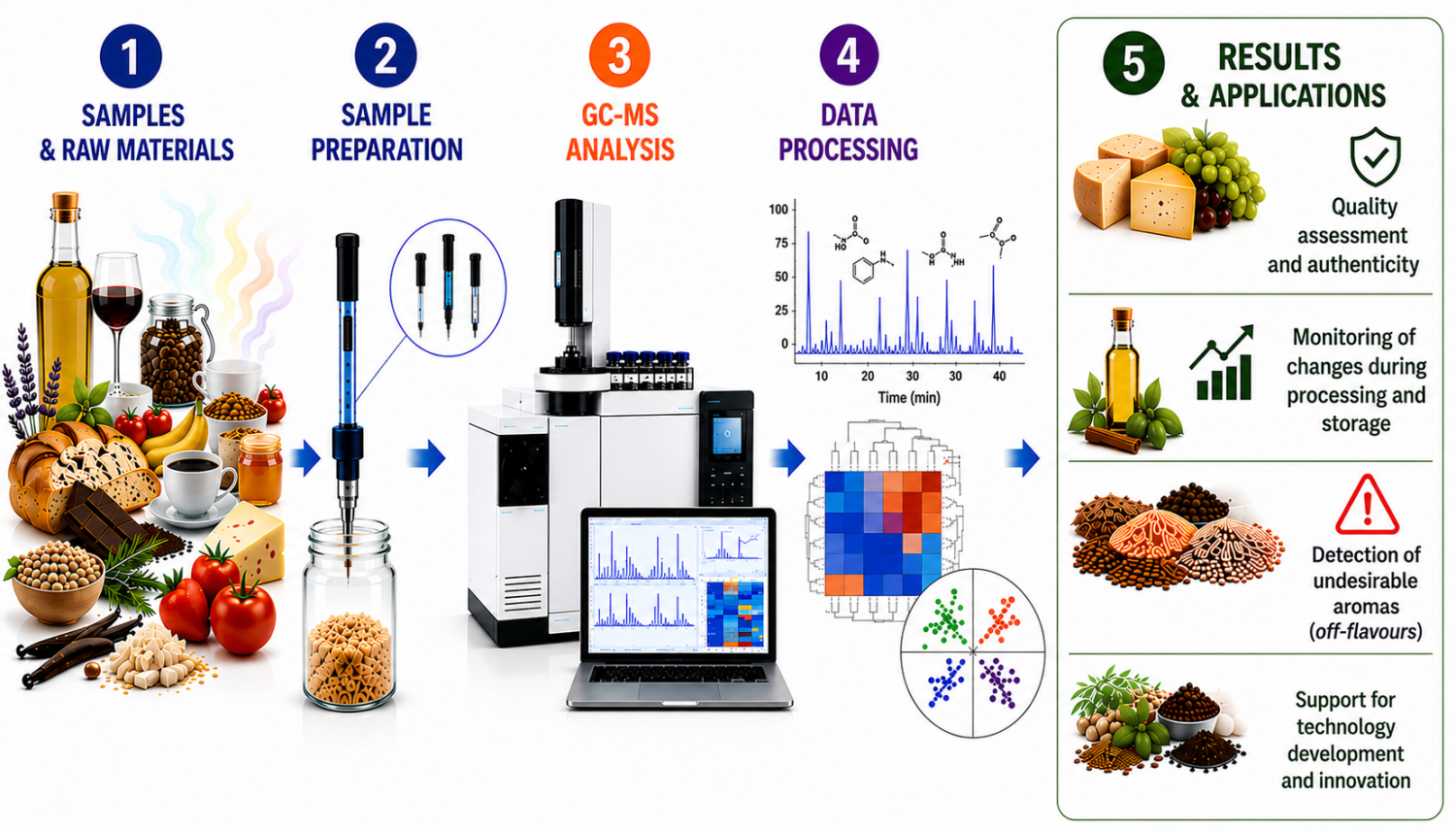
Analysis of Volatile and Semi-Volatile Compounds and the Application of Volatilomics in Food
What compounds influence the aroma of foods, and why do some products exhibit undesirable odor or taste notes? We study the profiles of volatile and semi-volatile compounds in foods, food raw materials, and ingredients, and investigate how their composition affects the sensory quality, authenticity, and acceptability of products. We focus on the identification of compounds responsible for desirable and undesirable aroma characteristics, including compounds responsible for so-called off-flavours. We investigate the influence of raw material origin, cultivation conditions, technological processing, and storage on changes in aroma profiles and seek chemical markers of quality, origin, and sensory changes. We employ advanced analytical techniques, particularly GC-MS/MS, GC-HRMS, and SPME-GC-HRMS, enabling sensitive detection, identification, and quantification of aroma-active compounds in complex matrices. The knowledge gained contributes to a better understanding of aroma formation mechanisms, the assessment of food quality and authenticity, and the development of technological processes aimed at improving sensory properties.
Metabolic Profiles and Bioactive Compounds in Plants
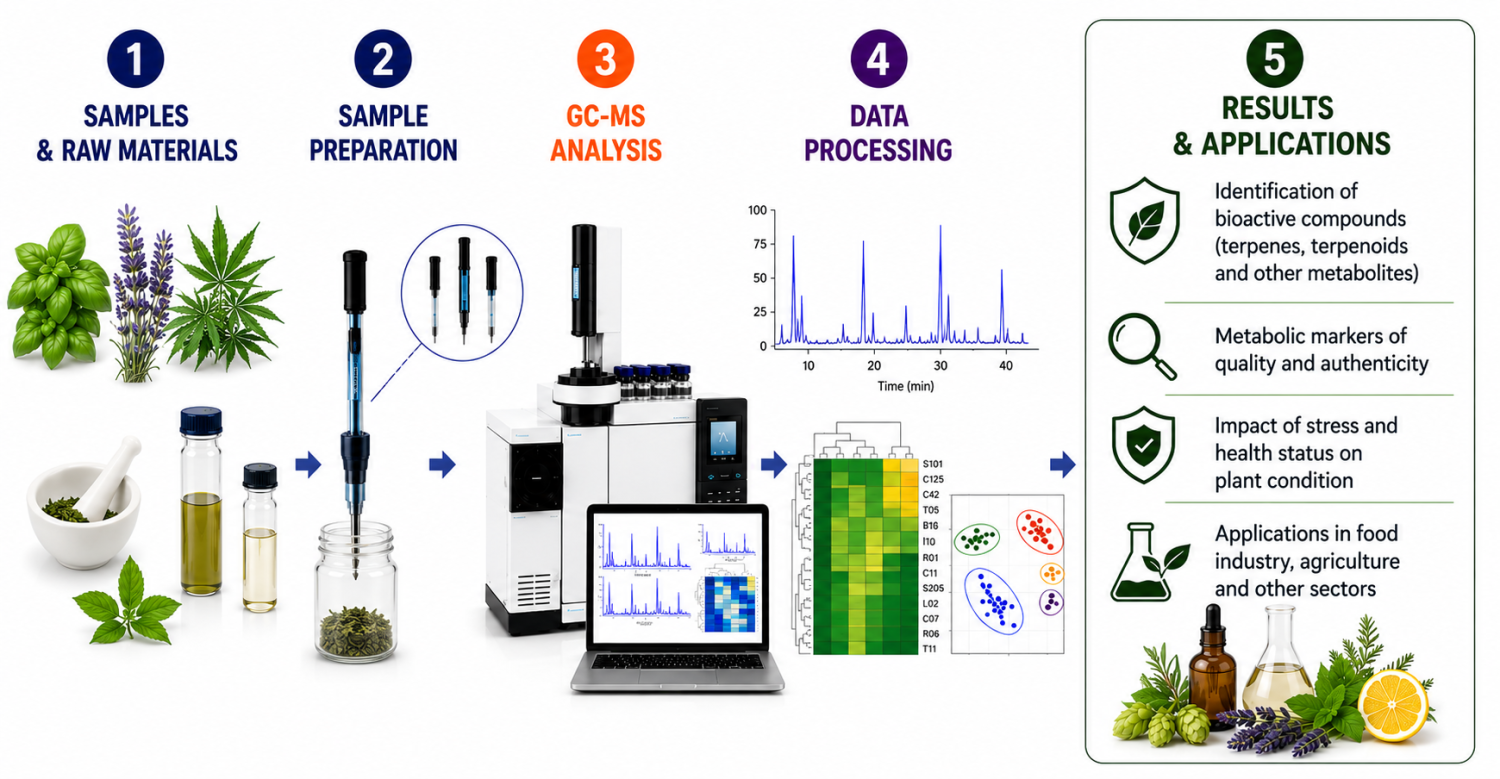
What compounds determine the biological properties, aroma, and quality of plant materials? We study the metabolic profiles of plants, focusing on the identification of terpenes, terpenoids, and other biologically important metabolites that influence their properties, functions, and applications. We investigate how the composition of these compounds changes depending on genetic factors, cultivation conditions, plant health, and exposure to environmental stressors. We employ advanced analytical approaches based on GC-HRMS and GC-MS/MS techniques, enabling the comprehensive characterization of volatile and semi-volatile metabolites. The obtained data are processed using advanced statistical and bioinformatic tools to identify metabolic markers, assess the quality and authenticity of plant materials, and elucidate biological processes occurring in plants. The results contribute to a better understanding of plant metabolism and expand the potential applications of natural compounds in food science, agriculture, and other applied fields.
Stupák M., Filatova M., Beneš F., Bínová Z., Hajšlová J.: GC–MS strategy for a comprehensive assessment of cannabis metabolome. Microchemical Journal (2025) 210: 113062. (doi: 10.1016/j.microc.2025.113062)
QL25020024 Introduction and implementation of monitoring of selected aroma components in relevant foods available on the Czech market to evaluate health risks (Ministry of Agriculture, 2025-2027)